The Western Ghats is considered one of India’s most beautiful scenic destinations. A home to a wide variety of species belonging to the plant and animal kingdom, it is one of the four biodiversity hotspots in the country. These hills are considerably high and steep in comparison to the eastern counterpart, and their heights decrease as one comes down from Maharashtra to Kerala.
The monsoon winds entering from the Malabar, strike these hills bringing heavy rainfall near the coast (windward side); and the upland Deccan, being the rain shadow region gets lesser rainfall. Due to this, the region of Western Ghats is heavily forested, naturally fortifying the Deccan plateau on the western front. The coast and the hilly regions are also extremely fertile, rendering agriculture and production of other commodities profitable; whereas the rain shadow upland always had to depend on tank irrigation. It has been widely accepted after various theories and interpretations, put forward over the years in historiography that ‘geography of a region’ is one of the most important factors ‘determining history’. This is not only justified by the role of rivers in the rise of the earliest civilizations, but also geographical factors such as these which determine (in this case) the pattern of rainfall and the possibility of agriculture and settlements.
The Western Ghats region is called Malenadu or Malnad in Karnataka. ‘Male’ in Kannada means rain and ‘nadu’ denotes place or region. The heavy, constant rainfall led to this region, being christened as such. Densely forested Malenadu, was home to various tribal groups since ancient times and some still continue to exist. Their presence has however reduced, over the years due to development projects.
Going back to about 1000 years, a group of tribals from Malnad, came down to the mainland and over the years, with their superior fighting skills formed a great dynasty; contributing to politics, art, architecture and literature.
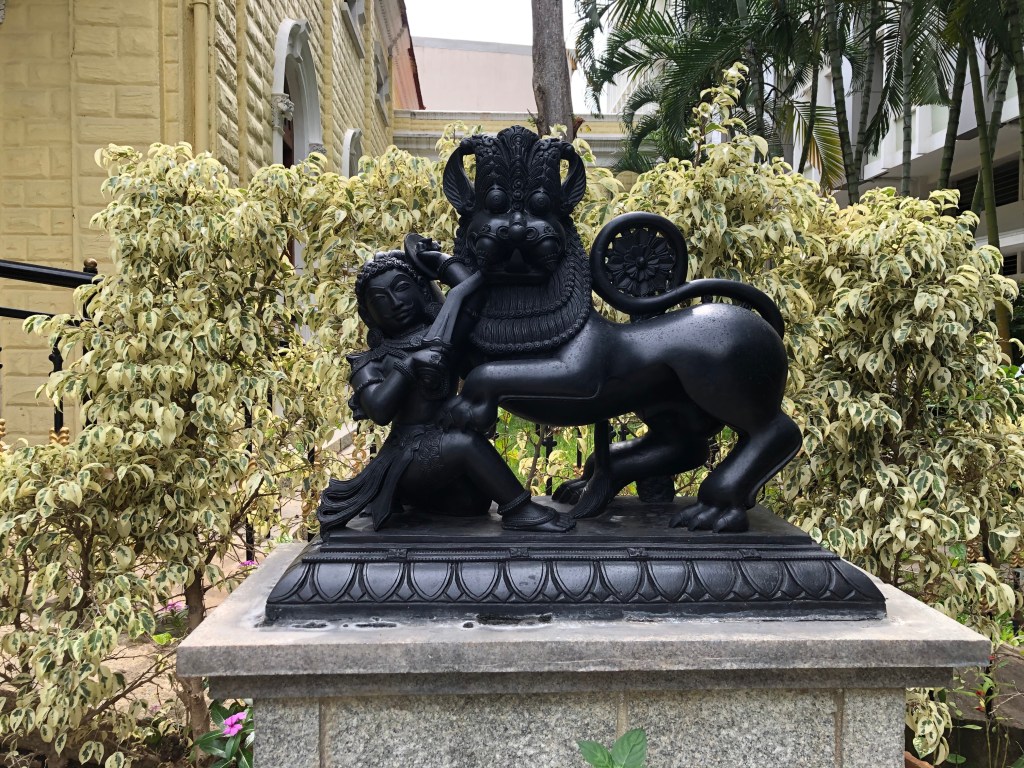
‘Hoysala’ was the name of these Malnad tribes, whose origin is believed to be the present day Angadi in Chikmagalur district. The territorial extent of control during their peak was the present day region of Karnataka, or perhaps a bit lesser than that. However it would be inappropriate to disregard their importance based on size (in comparison to the previous empires) and the localization of the dynasty in the Kannada territory, for two main reasons; the significant feature of that period was that of constant power struggle between four dynasties in south India (this feature has been discussed in the previous article on Kakatiya Ganapati) and no dynasty held large territories like their predecessors or their common successor Vijayanagara. Another reason being Hoysalas’ contribution to architecture, which is unparalleled in Indian Art history. Nevertheless, one of the major factors responsible for their rise to prominence was their superior fighting ability, because of which they were even employed as mercenaries.
So what about the fighting abilities? How was it different from that of others?
In the history of mankind, the transition from tribe to sedentary living has never happened without an impetus. The banks of river Ganga and their periodic development and urbanization from the times of Mahajanapadas would have never have happened without an impetus; the entry of the Aryan Way of life, introducing iron which made it possible to clear the earlier densely forested Ganga valley. Hence wherever the introduction of iron was late (due to inaccessibility) or agriculture was difficult due to the terrain, the tribal way of life continued; continue till now!
The dense forests and the steep terrain made agriculture and settlement difficult in the Western Ghats region. Hence the tribes, lived by hunting and gathering. To augment their hardships was the hilly, difficult terrain and the massive rainfall which would flood the existing few paths leading to the plains, further isolating them from the plain dwellers! These tribes generally made a living by selling sandalwood or flesh of wild boars which was even their diet. Occasionally when wild animals intruded into the territories of common people in the plains, there was no other option but to hire the Malnad tribes who made a living by killing beasts, kidnapping women or looting cattle from the farms !
Sedentary living, denotes the progression from hunting -gathering to settled phase! Interestingly the word sedentary originally means lazy and inactive. Hence the physical strength of a tribal, who lived by hunting and gathering in harsh, rainy conditions, would have been invariably greater than that of a normal plain dweller.
Not much has changed; the difficult terrain can still be experienced while driving through the Ghats. Hair pin curves and high chances of skidding due to the wet conditions makes it an accident prone region, to be ventured only by experienced drivers !
Hoysalas who came down to the mainland, showed their presence in public domain from early 12th century, attempting to overthrow the Chola rule in the region of Southern Karnataka, called Gangavadi-96,000. It was a period of the ‘Glorious’ Chola epoch and the Hoysalas struggled to drive them away and often allied themselves with the Later Chalukyas or Chalukyas of Kalyani (present day Gulbarga). The Chola inscriptions while celebrating their victory against these minor offensives, do acknowledge the formidable Hoysalas !
Kalyani Chalukyas or Later Chalukyas were the contemporaries of Cholas and Eastern Chalukyas. They held sway over the entire region of present day Maharashtra, parts of Andhra, Gujarat and northern Karnataka; southern Karnataka was held by the Cholas.
Kalyani Chalukyas constantly got into conflict with the Cholas in their southern frontiers. In this pursuit they took help of Hoysalas, who belonged to the South Karnataka (Malnad) region. But their prowess as exemplary fighters was proved in an unknown turf as well !
Kalyani Chalukyas naturally tried to extend their northern borders and intruded into Malwa, locking horns with the Paramaras.
Paramara-Chalukya conflict dates back to the time of earliest ruler of Kalyani Chalukyas, Tailapa and continued over many generations. Bhoja was one of the most popular and celebrated warriors of the Paramara dynasty, believed to be the founder of the City of Lakes- Bhopal and also many literary accolades to his name.
Bhoja, who ascended the throne of Malwa in the beginning of the 11th century, continued this conflict with the Kalyani Chalukyas; his contemporaries being Jayasimha-2 and during his final years Someshwara-1 (Ahavamalla Somehswara). He even formed an alliance with the Cholas in the south, against Chalukyas. However during the final years of Bhoja’s reign, which lasted for about half a century, Someshwara launched an attack on Dhara, which was the capital of Paramaras in Malwa. Bhoja lost this battle, which must have happened during the mid 11th century but is believed to have somehow recovered Dhara. When Bhoja died, his successor Jayasimha took control of Malwa.
But the Paramaras had way too many enemies, all eyeing the fertile, mineral rich Doab region of Malwa. No wonder Bhoja is considered the greatest of warriors, for having had to secure his turf despite so many eyes on it !
Hence when Jayasimha took over after the death of Bhoja, he was attacked on the East and West; simultaneously planned by Kalachuri Karna of the Tripuri kingdom and Bhima belonging to Chalukyas of Gujarat. Jayasimha, who was completely helpless, went to Someshwara for help. Someshwara gladly accepted and sent his capable son Vikramaditya-6 to drive the intruders away.
Vikramadtiya-6 was an efficient warrior, administrator and one of the greatest of Kalyani Chalukyas.
Someshwara-1 was initially succeeded by his eldest son Someshwara-2 (Bhuvanaikamalla Someshwara). He became apprehensive of his younger brother Vikramaditya’s alliance with Jayasimha which was believed to have happened when Vikramaditya restored him the kingdom. Hence Someshwara-2 ordered an attack on Dhara.
In this offensive against Dhara came the role of the Hoysalas, who had already proved themselves in the south and their prowess had no wonder urged Someshwara to send them to a totally foreign land, against foreign foes; to reduce a fort in the heartlands of Malwa.
The Hoysalas were ruled by their chief Vinayaditya. On the orders Someshwara, Vinayaditya sent his son Ereyanga along with the troops. Hoysala Ereyanga marched to Dhara, defeated the Paramara army.
Jayasimha was killed in action.
An inscription at Belur, dated 1117 AD (E.C-5, Belur-58) describes the event as follows:
“The overpowering Poysala burnt together the
fortresses that had been the pride of Bhoja, so that
the smoke entered the eyes of the lords of the quarters
and blurred them; the smoke all around smudged the whitish
tusk of the elephant at the quarters to make it appear
like (another) limb; and through its smoke the fire of his
fierce valor caused the region of the heavens
to be filled with flocks of clouds”
In another inscription at Nagamangala, dated 1164 AD (E.C-4, Nagamangala-30)
“Overcoming with his own army Dhara the mighty,
called the foundation of the Malava kingdom, and fostering
the prowess of his own arm so that victory might increase
for the emperor, king Ereyanga set up in the northern
region the standard of his fame, which was notorious for
victories in the quarters, in such a way that the Sun
shuddered to see it”
These are however poetic references to the campaign, issued by the Hoysala rulers themselves, much later. The victory in a completely foreign soil was something they cherished for generations and invariably used it in inscriptions to politicize their might. The Belur inscription mentioned above, refers to Dhara as “Pride of Bhoja”. It has to be however noted that Bhoja was in no way, a part of this battle!
He had passed away much earlier with the throne passing on to Jayasimha. But the Hoysala inscriptions associate Bhoja to Dhara fort, intentionally as he was a great warrior and by doing so, they would have sought to magnify the effect of their conquest.
Nevertheless, sources other than the Kannada inscriptions, claim that that Ereyanga was not alone in the campaign. Someshwara was also assisted by Kalachuri Karna, who was earlier driven out by Vikramaditya. In fact, the attack was planned and launched by an alliance of three kings; Someshwara, Kalachuri Karna and third king’s identity is debated (Ganga Udayaditya is believed to be the third king). Ereyanga’s presence is accepted by all the sources, but whether he was an ally as mentioned or a mere chieftain appointed by Someshwara is unknown. But there is absolutely no doubt that Ereyanga led a troop of Hoysala fighters.
Nevertheless, undermining the role of the Malnad fighters would be gravely unfair. The Hoysalas during the time of Vinayaditya (Ereyanga’s father), didn’t have control over a large territory. The territorial control of Hoysalas reached it’s zenith only during the reign of Ereyanga’s son Vishnuvardhana and great-grandson Ballala-2, making inroads to Tamil Nadu and northern Karnataka. In fact till Vishnuvardhana came to power, Cholas had not yet been rooted out of Ganagavadi (southern Karnataka).
So one may infer that the Hoysala kingdom, was a very small entity with absolutely no reputation of an independent kingdom during this campaign. Their army strength in numbers also would have been quiet meagre. At such a stage if Someshwara had to recruit Ereyanga, then it would definitely have to do with their capability and fighting prowess.
Hoysalas’ victory in foreign soil as mercenaries, doesn’t end with Ereyanga’s Dhar campaign. Ereyanga was also appointed to fight in Chakrakuta (present day Bastar, Chattisgarh) held by the Kalingas and Beleyapattana (recognized as present day Valapatttanam in Kannur, Kerala) held by the Mushaka rulers of Ezhimalai.
How fair would it be to evaluate the impact or greatness of a ruling clan or kingdom by only it’s territorial expanse ?
‘Greatness’ is yet again subjective and to appreciate the influence and impact of Hoysalas or any such kingdom, calls for understanding of history in it’s own terms. Approaching this period of medieval south India by respecting the social, economic, political and other conditions; not resorting to comparison with another era or time period becomes important. Every period had it’s own set of requirements, challenges and and what happened, was what the circumstances or conditions provided for.
Let’s not forget that, though the notion of India is widely debated and perhaps considered to be an identity conforming to the political boundary after independence; contacts and connections between different parts of the country- cultural, political and linguistic are much older than we perceive and these have also been continuous and dynamic.
REFERENCES
- Muthanna, I. M. (1962). History of Karnataka- History, Administration and Culture. Mysore, Karnataka: Usha Press, pp.88-91
- Aiyangar, S., 1911. Ancient India. Chennai: S.P.C.K Depository, Vepery, pp.227-234
- Singh, M., 1984. Bhoja Paramara And His Times. Delhi: Bharatiya Vidya Prakashan, pp.39-60.
- Coelho, W., 1950. The Hoysala Vamsa. Mumbai: Indian Historical Research Institute.
- Ganguly, D., 1933. History Of The Paramâra Dynasty [Of Ancient India]. Ramna, Dacca: Univ. of Dacca pp.127-130
- K.A.Nilakanta, S., & R. (1997). A History of South India: From Prehistoric Times to the Fall of Vijayanagar (4th ed.). Oxford University Press.
- Kunte, B. (1969). Maharashtra State gazetteers. Bombay: Directorate of Government Printing.
- Sastri, V. (1947). THE LATTER DAYS OF BHOJA “THE GREAT”. Proceedings of the Indian History Congress,10, 260-268. Retrieved September 6, 2020, from http://www.jstor.org/stable/44137143
- Mirashi, V. (1941). NEW LIGHT ON THE HISTORY OF THE PARAMARA DYNASTY. Proceedings of the Indian History Congress,5, 256-260. Retrieved September 6, 2020, from http://www.jstor.org/stable/44304733
- SINGH, A. (2012). Interpreting the History of the Paramāras. Journal of the Royal Asiatic Society,22(1), 13-28. Retrieved September 6, 2020, from http://www.jstor.org/stable/41490371
- Seth, K., 1963. The Growth Of Paramara Power In Malwa. Ph.D. Dr. Harisingh Gour Vishwavidyalay. Redirected from https://shodhganga.inflibnet.ac.in/handle/10603/44685
- Derrett, J. D. M. (1949). The dynastic history of the hoysala kings (Order No. 10752588). Available from ProQuest Dissertations & Theses Global. (1984983099). Retrieved from https://lavasalibrary.remotexs.in/docview/1984983099?accountid=38885
- M.S, D., 2016. The Dynamics Of A Supra-Regional Power: Hoysalas In The Medieval History Of Kerala. Ph.D. Pondicherry University. http://www.heritageuniversityofkerala.com/JournalPDF/Volume4/40.pdf
- Raychaudhuri, G. (1948). The history of the western chalukyas (political and administrative) (Order No. 10731277). Available from ProQuest Dissertations & Theses Global. (1976942038). Retrieved from https://lavasalibrary.remotexs.in/docview/1976942038?accountid=38885
 Anuroop Tantry