“When the passions of the past blend with the prejudices of the present, human reality is reduced to a picture in black and white.”- Marc Bloch
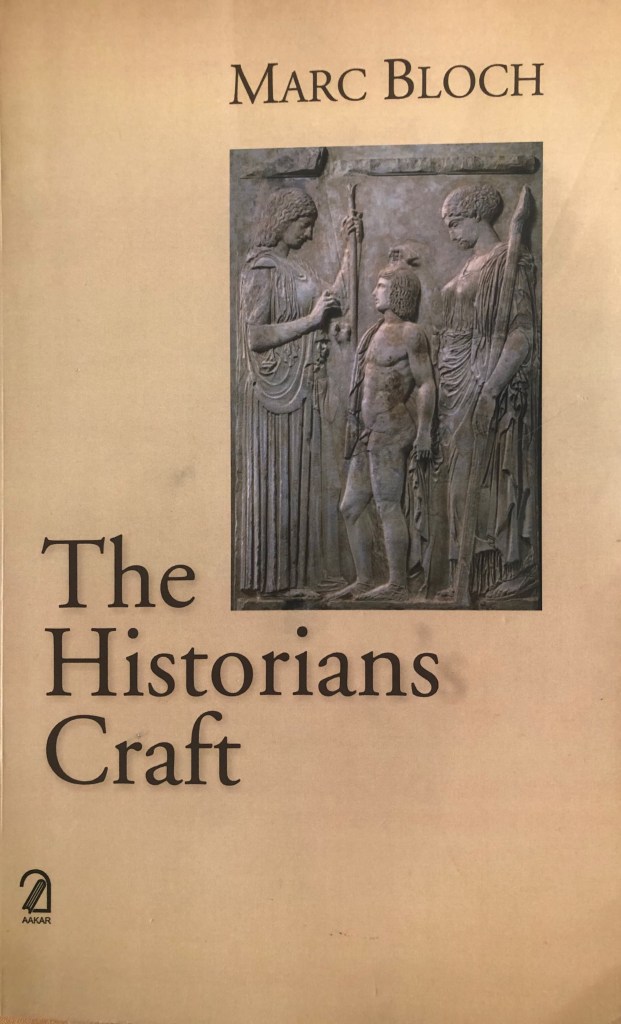
The 20th century produced a fair share of genius historians, who stood out among the rest in parallel to the developments happening in modern historiography; or to be more precise, the way ‘History’ itself was being perceived. Unlike the Historical writings of the 19th century which was characterized by a strong sense of sanctity for ‘facts’; the early 20th century had luminaries like R.G Collingwood, Benedetto Croce, Carl Becker who questioned history’s fetish with facts, paving way for a ‘Philosophy of History’. In short, the stage was set for a more renewed understanding of History, much different from the 19th century ‘fact-maniac’ political histories ! It is in this new era which called for a more profound, nuanced understanding of the past, that Marc Bloch appears as one of the most revered and impactful historians.
Undoubtedly his pioneering role along with Lucien Febvre in what we know today as ‘Annales School of Historiography’ stands out as one of the most significant reasons as to why Bloch is celebrated today. Looking back in hindsight- especially considering the wide range of historians and philosophers, post modern theorists like Foucoult and Derrida- one can’t blindly accept all the tenets of Annales school. Like all historians and schools of historiography, they are ultimately a product of history.
If one ponders upon other reasons, as to why Bloch is still relevant (and going to be for many more years) despite the drawbacks which visibly appear to us in hindsight- the answer lies in looking beyond the theories of historical method put forward or endorsed by him. Bloch’s insights and profound understanding of the past and its nuances; including the nuances of historical writings1, nature of sources, mass psychology, nature of man, critical method and mentalities are remarkable; and, cannot always be forced to fit into theoretical frameworks. It is precisely for this reason, Historian’s Craft becomes a must read for both aspiring scholars/historians and history enthusiasts. The work is a testament to the above mentioned insights – or if a more precise term can be used- a keen historical sense. A sense which the scholar/ historian-in training is duty bound to cultivate; but is no less important for a history enthusiast/’curious non-professional’. In fact Bloch avowedly presents an overview of ‘why and how a historian practices his trade’ after which the reader (not just the professional) can decide its use2. For a scholar (in-training or trained), the book may not be crucial in terms of intellectual/theoretical dividends; but surely an inspiration3, in terms of the historical sense to be cultivated (even if it isn’t on the same lines).
Moreover there is an interesting background to the book and the writer; which makes it hard for Bloch or this work to be any less of an inspiration; it was written amidst World War-2. A war to which Bloch was no mere spectator owing to his professional and academic credentials. Having fought the first World War, Bloch (also a Jew) was called to serve in the second World War in 1939 at the age of fifty three4. He was captured by the Germans in 1944, tortured and later shot in an open field.5
His state of mind is mentioned (very briefly and indirectly) in the dedication to Lucien Febvre at the beginning of the work;
If this book should one day be published-if begun as a simple antidote by which, amid sorrows and anxieties both personal and collective, I seek a little peace of mind….6
Like Carr mentioned, ‘a historian is also a product of history’; albeit in a totally different context, the blatant reality of the statement cannot be denied, considering the case of Bloch, who was a victim of one of the most violent contours of history !7
Nor did he have at his disposal sufficient materials in terms of books, manuscripts etc., for this work. In the introduction he laments,
“But, before proceeding to this question, let me insert one word of apology. The circumstance of my present life, the impossibility of reaching any large library, and the loss of my own books have made me dependent upon my notes and upon memory. Both the supplementary reading and the research demanded by the very laws of the craft I propose to describe have been denied to me. Will it, one day, be granted to me to fill in the gaps entirely, I fear. I can therefore only ask indulgence. I should say: “I plead guilty”, were it not that, by so doing, I might seem overly presumptuous in assuming responsibility for the evils of destiny.”8
The nature of the work and the conscious motives guiding it, are briefly expressed in the Introduction. Here Bloch starts with the question, ‘What is the use of History?‘. The question betrays a sense of naivety in scholarly standards – totally unexpected from the likes of Bloch- and goes ahead with a rather grim tone. If one tries to understand the circumstances Bloch was encountering- a crisis in the world around and as a result within, a more pressing need to ‘understand‘ men, and also a phase where the understanding of History was looking for a new direction shedding its old cast of Positivism and ideas like ‘facts speaking for itself’ (which was again not uninfluenced by the external world)- the unusual beginning becomes more intelligible.
The book comprises of six chapters namely, History, Men and Time; Historical Observation, Historical Criticism, Historical Analysis and the incomplete Historical Causation. According to Lucien Febvre, Bloch had anticipated seven chapters in a plan; but never followed it accordingly.
The idea here, is not to give a complete summary of each chapter, which would get too dry and also not do justice to the joy of reading Bloch’s keen narrative (albeit translated, for the ones who can’t read French). Rather, it would be more wise to point out the insights and sensibilities, which appear timeless.
In the first chapter, on History, Men and Time, Bloch specifies that the object of History is not the past, but men9. The pursuit is to understand men, who are not studied in an abstract sense but as beings who conducted and interacted themselves in historical time. The thoughts and values of the men were very much rooted in historical time, which again, according to Bloch, is no abstract entity ‘but a concrete and living reality with an irreversible onward rush’, ‘the plasma in which events are immersed’ and become intelligible10. In short, the thoughts and values through which wo(man) engages with his/her social world are historically contingent and not eternal unchanging realities. This is a subtle point with overarching significance and relevance, especially when almost unconsciously, individuals and also the so-called ‘professional historians’, go about making judgements about the past. That their judgement is rooted in the ‘thoughts and values’ of the present and is directed at a past when these didn’t exist, seems to be a bitter pill to swallow.
Interestingly as much as Bloch bats for the thoughts and the mind of man at constant flux, he asserts that, there are aspects of human nature that has not changed; if not owing to which, it would be impossible to understand the society (its past or present).
In the same chapter Bloch engages with a discussion on the oft cited, ‘Idol of Origins‘. A very common obsession of historians and dilettantes, is with ‘origin theories’- origin of a race, ideas, a people, language. As innocent and curious, this quest seems, it is loaded with dangers which Bloch sheds light on. The ambiguous nature of the term origins is pointed out, where it is often taken to mean ’causes’ or ‘beginning’ and, what often happens is the contamination of both. The search for origins, subtly transforms into an an inference of the cause11, resulting in linear suppositions; making complex issues a victim of value judgments. Be it the origin of a certain people (if they really existed), or certain words in languages whose meaning has changed over time; merely finding out the origins, often leads to misinformed and inchoate assumptions about the cause of the change, which are no less guided by the prejudices of the present. Bloch draws attention to much deeper questions like how and why changes/transformations/ diffusions happened, and why they happened at that point of time in history ?
In the second chapter on Historical Observation, Bloch along with discussing whether our knowledge of the past is direct or indirect, makes a crucial observation that, though our understanding of the past is bound and restricted by the tracks left by it, we are always capable of knowing more than the tracks seek to convey. This leads to another point, befitting a popular misinformed belief that historians just convey (or are supposed to convey) what the sources of history tell. A trained historian is duty bound not to just produce an account, the way sources speak. Sources are not treated with undue reverence and obeisance; rather they are rigorously cross examined to extract information which are not discernible directly. This very process makes a historian vulnerable to the threat of ‘distorting’ history; that there can be a history which is an exact product of the past is unfortunately, rather an illusion !
In the next chapter on ‘Historical Criticism‘, Bloch takes an interesting detour to trace the history of ‘Critical Method’. As mentioned earlier, a method involving rigorous scrutiny and interrogation of the source used by the historian not just to judge the validity/authenticity of the source; but also to enable it, to give more insights about the past than it intended to12. Its rather interesting, how Bloch laments the general public scarcely knowing how historians operate with this method; and lays the blame on historians for the unwarranted modesty of not openly holding on to the very methods which make them professionals. Whether the public today, is aware, that such a method exists will surely evoke a dubious response; as there are many who masquerade as messiahs for presenting ‘the facts of history as it is’, attacking professional historians for distorting the facts13. That presenting the facts ‘as it is‘- which is mostly in line with the prejudices of the present- is also going to make their so-called resurrected history ‘distorted’, is barely acknowledged !
The next chapter on Historical Analysis, starts with a short but impactful discussion on, Judging or Understanding. Whether we, as students of history, must approach it with the motive of Understanding or Judging ? Bloch does not delay in expressing need for the former rather than the latter. Our judgments are always rooted in the present- or rather the prejudices of the present ! Here are some excerpts from that section, presented here solely because the author (and/or translator) has delivered them with a degree of perfection, hard to paraphrase !
“Are we so sure of ourselves and our age as to divide the company of our forefathers into just and the damned? How absurd it is, by elevating the entirely relative criteria of one individual, one party, or one generation to the absolute, to inflict standards upon the way in which Sulla governed Rome, or Richelieu the States of the Most Christian King ?“14
“When the passions of the past blend with the prejudices of the present, human reality is reduced to a picture in black and white.”15
“Moreover, to plumb the consciousness of another person, separated from us by the interval of generations, we must virtually lay aside our own ego, whereas, to say what we think, we need only to remain ourselves. This is a less arduous endeavor.“16
Noteworthy, is also the section on From the Diversity of Human Functions to the Unity of Consciences. In this section Bloch starts by explaining how all systems of knowledge segregate, organize, classify and specialize in order to understand better and deeply, as the limited scope of mind permits. Even historians segregate aspects of religion, economy, trade to understand each of it more lucidly. But while scientists can study physical and natural world by dissecting; a historian, while for sure can dissect, is tasked with a challenging feat, as the human consciousness perceives everything together without segregation. As Bloch says,
The difficulties of history are of still another nature. For in the last analysis it is human consciousness which is the subject matter of history. The interrelations, confusions, and infections of human consciousness are, for history, reality itself.17
The connection drawn by the likes of Max Weber between, Protestant ethic and Capitalism can be understood in this context. As Bloch asks,
Were Pascal, the mathematician, and Pascal, the Christian, strangers to each other ?
Such questions become more important while trying to understand capitalism, scientific revolution, modernity in context of Europe. Were such developments, especially the rise of modern ideas, institutions and scientific developments complete strangers to faith and belief systems like Christianity ? Like the age old ‘science vs belief’, ‘modernity vs tradition’ debates would have us believe !
The last incomplete chapter is on Causation, where Bloch blatantly barrages the fetish with cause; especially the search for a single cause, with value judgement lurking behind. He claims that a graduated classification of causes is only an intellectual convenience18. A valid argument that human actions in past were not always a result of logic and self interest is also made. He even ends up asking a loaded question,
Does anyone consider that the moral atmosphere in which we are currently plunged comes only from the rational part of our mind ? We should seriously misrepresent the problem of causes in history if we always and everywhere reduced them to a problem of motive.
In this incomplete chapter, Bloch’s call for a more rigorous, nuanced and mature engagement with the idea of causes in History.
These are just few of the many insights which stood out, especially in terms of their continued relevance. The interesting feature in the book is that, none of the insights (the few mentioned, and the many others not mentioned ) are presented as diktats or postulates. Bloch keeps highlighting the element of complexity and nuance in every topic and sub topic dealt. The ‘historian’s craft’ is not rigid/infallible; it can also prove to be a double edged sword. Bloch’s writing unfurls as a discourse and dialectic; he doesn’t easily allow you to agree with his own points. There is an alarming sense of caution, in every incisive observation about the past and its sources, giving due reverence to contextuality and complexity. The nature of Bloch’s work in fact embodies the nature of Historical studies, in all its attributes-
Discursive, subtle, nuanced, complex and contextual.
NOTES
- Contrary to the general ignorance in common parlance; past and History are different. History referring to the writings about the past, rather than past itself ↩︎
- pp.12 ↩︎
- If I may dare to use, such a blatantly overuse word ↩︎
- pp. vii- Introduction ↩︎
- pp. viii- Introduction ↩︎
- pp. v ↩︎
- If you had the patience to scroll down; here is a more subtle correction not history, past ↩︎
- pp.6-7 ↩︎
- The term has been italicized for two reasons. One, Bloch consciously prefers the plural denotive ‘men’ over the singular ‘man’. Two, albeit respecting the larger point being made, the lacking gender sensitivity is glaringly visible. Whether such an indictment is anachronistic or not is subject to debate. ↩︎
- pp.27-28 ↩︎
- Often, a single cause ! ↩︎
- There is a pressing need to understand that sources like royal charters, edicts, royally sponsored contemporary accounts and histories, proclamations from authorities, inscriptions were created with motives of future. Irrespective of the nature of the future in their minds, they embody the way, they (the group sanctioning) wanted to comprehend their actions or others to comprehend their actions. By taking them at a face value, we are openly falling into a ditch, which they wanted us to fall into ! ↩︎
- A common barb of Youtube historians ‘or fact revivalists’ ↩︎
- pp.140 ↩︎
- ibid ↩︎
- pp. 140-141 ↩︎
- pp. 151 ↩︎
- pp. 192-193 ↩︎
 Anuroop Tantry