Unlike popular belief, ‘facts don’t speak for themselves’. The historian’s interpretation is crucial for the formulation of a historical fact.
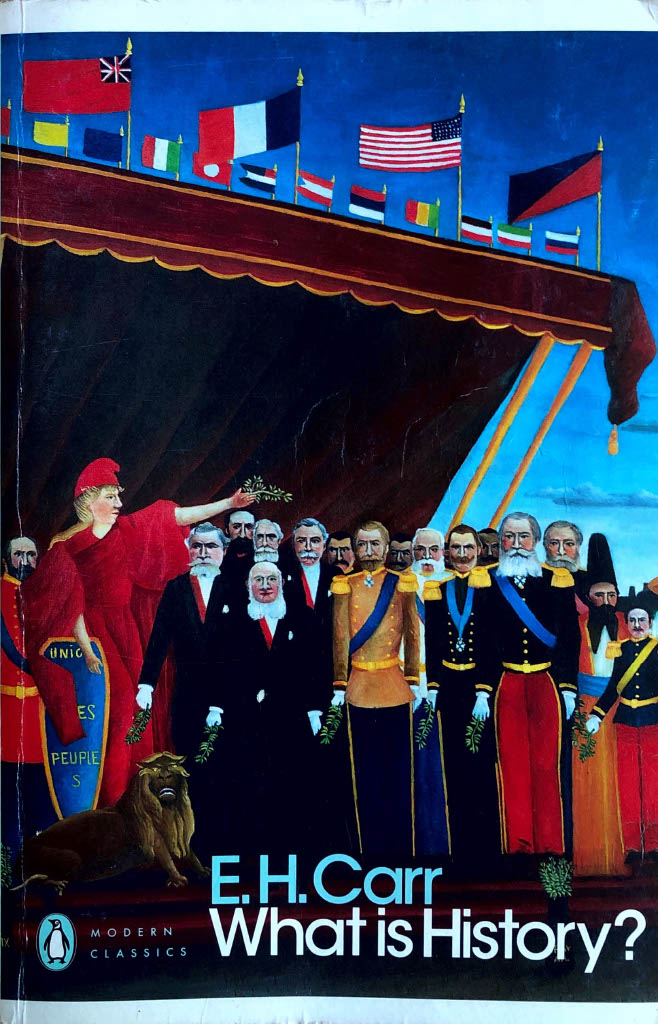
English diplomat, journalist and historian E.H Carr’s ‘What is History?’ is a book whose relevance is not going to die down any time soon. While it is certainly an essential reading for a beginner taking academic history courses in Undergraduate studies; a serious engager in the discipline is understandably expected to go beyond Carr and stay updated about the advances in historical theory and historiographical studies. But the fact that it has consolidated its position as a foundational work for students and history enthusiasts is of no surprise.
It is for the popular readership and ‘history enthusiasts’ with a non- academic (or more precisely a non-historiographic background) that this book becomes a must read. As a subject taught to students in school, appearing as one of the major areas of intervention and politicization through ‘national’ curriculums’; its association with identity formation/internalization is no big secret. Getting students acquainted about their history (or indoctrinating students, if we are allowed to be a bit more open about ‘nationalist projects’ in general) is with the purpose – along with the other openly stated/ obvious objectives- of enabling students to formulate an idea of ‘Who they are?’ and their supposed ‘roots’. There are committees set up (whose composition is determined by the ruling govt) which decide upon the content of the history text books and most importantly write books which are comprehensible to young readership. Inevitably there is a ‘dilution of subject matter‘, to facilitate teaching and understanding. As a result of which, history- for students or adults who have studied the subject only until lower secondary- is generally an assortment of facts, which they are (or were made to) learn by rote. The perception of history is about a set of facts crafted into rigid singular narratives; totally unaware of its flexibility and dynamism. While this may not be a problem in countries with not so complex pasts; in countries like India with centuries of recorded history- inhabited by societies with strong religiocultural affinities- history more often than not becomes a zone of contestation with the interests of dominant power blocs playing a not so invisible hand. It is in such societies where there is going to be prevailing confusion over ‘past and history’, the question of ‘What is History’ becomes fundamental. Carr, in a book no longer than 151 pages directly takes on issues of seminal importance like Facts, Causation, Society/Individual, relationship of History with Science/Morality and concepts like Progress.
In the first chapter on ‘Historian and His Facts‘, Carr specifies the distinction between ‘facts of the past‘ and ‘historical facts’. Unlike popular belief, historical facts don’t exist by themselves; rather, it is the historian who is selective of facts because s(he) deems it important to support an interpretation. Most importantly it is only with the due intervention of the historian (who uses it to support his/her interpretation) that its status as a fact is determined. This also dispels an important myth as regards to the ‘facts’; the latter don’t speak for themselves (as is generally believed), a historian’s interpretation becomes imperative and, with the interpretation comes the subjective element. Whether history can be objective or is always subjective, is a discussion which spills across chapters and Carr adopts a complicated position with regard to this. In the process, a definition of history is also worked, ‘…. a continuous process of interaction between the historian and his facts, an unending dialogue between the past and present‘.
In the second chapter on ‘Society and Individual‘ the plausibility of a dichotomy between society and individual is vehemently rejected. ‘Tendencies of the times’ in which the historian writes appear in the works irrespective of the period of past being discussed. Likewise a historian is also a product of history; hence the latter becomes a dialogue between the society of the past and the present. In the chapter on ‘History Science and Morality‘, Carr’s puts forward certain insightful and fairly profound points. A noteworthy one made by Carr, is that moral/value judgements can be made on institutions rather than individuals. The chapter on ‘Causation‘ amidst laying down the basis of its formulation, also touches upon interesting issues like ‘Determinism’ and ‘Chance/ Accident in History’; where Carr manages to make his point with considerable clarity. The chapter on ‘History as Progress‘, is where Carr further engages with the concept of objectivity and its basis (in future), where he builds upon the points made in previous chapters. The final chapter on ‘Widening Horizons‘, is a sort of conclusion, presenting Carr’s optimistic view of the ‘essentially teleologic’ History.
As mentioned in the introduction, the book’s relevance-especially considering its readability and the crucial insights made- does not really seem to be coming to an end, anytime soon. As for a student of History who seeks to engage deeply not just with the subject matter, but also the theoretical issues; Carr’s work is not without drawbacks. A sense of deep optimism and idealism can be observed when Carr, starts by making a very important observation with respect to facts- its deep connection with the historian’s interpretation, highlighting the subjective nature of history- but still posits that an ‘objective history’ is possible. The objectivity or progress) whose direction is towards a particular end is claimed to be towards no finite end, but ‘an end which is modified as we approach it‘. Such abstractions -on the basis of which affirmative positions are taken with respect to an objective history- is deeply problematic as it, by its very nature – of a constantly modifying end- contradicts itself. Moreover, postulating that moral/value judgements can be made against institutions (and not individuals), gives a free hand to make judgements, which are ultimately on the pedestal of values we stand on, today; rather than giving emphasizing on ‘understanding‘ as suggested by Marc Bloch in Historian’s Craft ( a much earlier book). Value judgements/moral judgements (notwithstanding the very nature of ‘word’) are not going to take us anywhere except, brew a set of emotions which inevitably gets capitalized by groups for political gains. Same goes with the ambivalent position taken by Carr with respect to the ‘Great Man Theory’, where- despite affirmatively stating that an individual cannot be separate from a society- he claims that the great men either ‘represent the existing forces’ or ‘forces created by them‘. While the former stands in conformity with his earlier view; the latter brings forth yet another question of whether the ‘Great Men‘ (and sadly not women in the opinion of Carr) can create such forces ? What constitutes these forces ?
Concepts like objectivity, teleological nature of history and causation are challenged more radically by the likes of Keith Jenkins and other Post Modern theorists of history; which comes under the larger purview of ‘Post Modern challenge to History’. All in all, when seen from the standards of its time, the book is indeed a crucial and a commendable work, putting on paper and bringing forth to discussion certain unconscious influences and underlying assumptions in history writing; even exposing the narrow Eurocentric standards of contemporary historians.
 Anuroop Tantry